Beyond the Black Box: How AI is Forcing a Rethink of Software Supply Chain
AI adoption is nearly universal across enterprises.
Governance maturity is not.
That tension is the central theme of our new research report, Beyond the Black Box: How AI Is Forcing a Rethink of the Software Supply Chain.
We surveyed 300+ security leaders across the United States and EMEA. What emerged is not panic. It is misalignment.
Executives believe their AI programs are mature. AppSec teams describe something more fragmented, more manual, and more uncertain.
That gap is where risk lives.
The Real Problem: Misalignment
Security leaders often believe AI governance is in place. In fact, 72.9% rate their AI security programs as complete or thorough.
At the same time, governance practices tell a more nuanced story. 57.8% of AppSec teams report managing AI separately from standard software processes, signaling fragmentation in how oversight is implemented.
When leadership and frontline teams disagree on readiness, risk decisions become inconsistent and accountability becomes unclear. Incident response slows, and audit and board conversations get harder. AI scales this misalignment quickly because it embeds itself across developer workflows, customer-facing products, and third-party services. If governance is fragmented, exposure compounds
Visibility Without Control Does Not Reduce Risk
Many organizations can generate artifacts and reports. Fewer can operationalize them.
For example, 60% generate SBOMs, yet more than half are not consuming or managing them in practice. Generation creates documentation, but it does not create operational control.
AI introduces models, datasets, and third-party services that sit alongside traditional software components. When those elements are not inventoried, tracked, and governed through a unified process, blind spots multiply. Teams discover exposure after deployment instead of preventing it before release. Developers lose confidence in signals that lack context, and friction rises across security, engineering, and procurement.
Point-in-time visibility does not scale in an AI-driven supply chain.
Shadow AI Is Changing the Risk Profile
AI adoption rarely waits for formal approval cycles. Tools and models are introduced to solve business problems quickly, then become embedded in workflows and products.
That reality shows up clearly in the data.
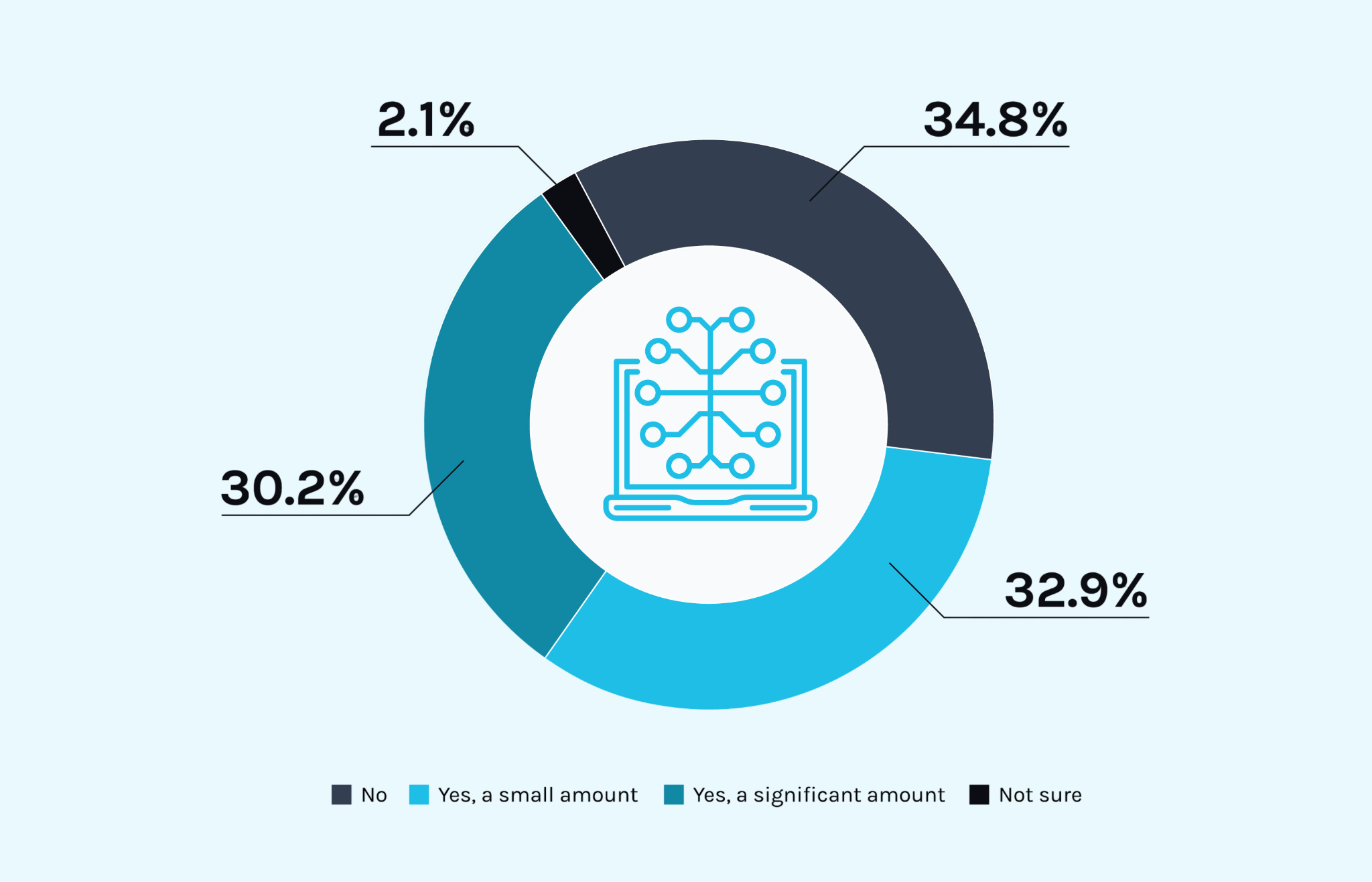
- 63% of organizations report shadow AI.
- Only 34.8% report having none.
Governance gaps are also showing up as business drag.
- 93% strongly agree they have significant room to improve in managing AI licensing and intellectual property obligations.
- 48.5% report delays or additional legal or compliance review tied to licensing or provenance concerns.
When organizations cannot answer basic governance questions consistently, shadow AI becomes institutional risk:
- What AI is in use?
- Who approved it?
- How is it monitored?
- What licensing and intellectual property obligations apply?
Detection Without Precision Creates Friction
56.3% of respondents say SCA tools create noise and delay. Nearly half remain skeptical that these tools meaningfully reduce risk.
This is a signal that detection alone is no longer sufficient. Without exploitability context, ownership clarity, and reachability insight, alert volume rises while confidence declines. Remediation slows because teams spend time triaging and debating findings instead of acting on defensible priorities.
AI components amplify this dynamic. More components without more precision increases friction instead of reducing risk.
Why Transparency Changes the Equation
There is a clear counter-signal in the research. Organizations that receive verifiable transparency data from vendors report measurable benefits:
- Faster implementation of new technology
- Faster resolution of security issues
- Reduced downtime
Transparency reduces investigation time and shortens decision cycles. It improves coordination between security, engineering, and procurement. The absence of transparency creates what we describe as the transparency tax, which is the time and cost spent investigating opaque components instead of making informed decisions.
Transparency is not about compliance optics. It is about operational speed and risk clarity.
Quick Win: Pressure-Test Your Inventory
Pick one AI-enabled product or business unit and conduct a focused inventory review. Map:
- AI tools and models in use
- Ownership and approval pathways
- How those components are tracked
- Where governance decisions are documented
- Associated licensing and provenance records
Even a limited exercise will surface gaps in visibility and accountability. If it takes days to assemble a reliable answer, that is a signal that operational control is not keeping pace with adoption.
Common Mistakes to Avoid
- Treating AI governance as separate from software supply chain security
- Assuming executive confidence reflects operational maturity
- Generating artifacts without integrating them into daily workflows
- Allowing parallel governance tracks to emerge
- Discovering AI usage only after it is embedded in production
The Bottom Line
AI is not introducing entirely new categories of risk. It is amplifying existing supply chain weaknesses and exposing where governance is fragmented.
It increases licensing complexity. It expands dependency surfaces. It tests alignment between leadership and practitioners.
Organizations that unify visibility, ownership, and operational control across software and AI will reduce friction and move faster. Organizations that do not will continue to operate with blind spots.
Download your copy of Beyond the Black Box: How AI Is Forcing a Rethink of the Software Supply Chain to see the full findings and benchmark your organization against the market.